
Hydrocarbon Source Rock Potential and Thermal Maturity of Baong, Peutu, and Bampo Formations in the North Sumatra Basin, Indonesia
DOI:
https://doi.org/10.25299/jgeet.2026.11.1.24519Keywords:
source rock, Geochemical, north sumatra basinAbstract
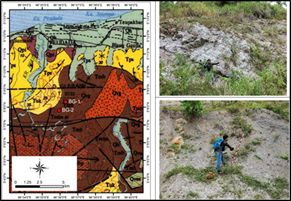
This study investigates the hydrocarbon source rock potential and thermal maturity of shale and mudstone outcrop samples from the Baong, Peutu, and Bampo Formations in the North Sumatra Basin, Indonesia. These fine-grained, calcareous, organic-rich, and low-permeability rocks are widely recognized as potential hydrocarbon source rocks. Source rocks generate hydrocarbons through thermal maturation processes, and their effectiveness is primarily controlled by organic richness, kerogen type, and thermal maturity. A total of six (6) outcrop samples were collected and analyzed using Rock-Eval Pyrolysis and Vitrinite Reflectance methods to evaluate their geochemical characteristics. The Baong Formation samples show very good organic richness, with Total Organic Carbon (TOC) values ranging from 2.2 to 2.5%, and are dominated by Type II/III kerogen, indicating potential for mixed oil and gas generation. Tmax values of 428–429°C suggest that these samples are thermally immature. The Peutu Formation samples exhibit very good source rock potential, with TOC values of 3.3–3.8% and predominantly Type II/III kerogen, suitable for mixed oil and gas generation. Tmax values indicate thermal immaturity to early maturity. In contrast, the Bampo Formation samples are thermally mature but display poor organic richness (TOC < 0.5%) and low Hydrogen Index values, suggesting limited hydrocarbon generation potential dominated by Type III kerogen. Although interpretations are based on outcrop samples, the results provide important implications for evaluating the petroleum system of the North Sumatra Basin, particularly in understanding source rock distribution, quality, and maturity trends.
Downloads
References
Afifah, P.D., Setiawan, B., 2019. Middle Miocene Black Shale of Airbenakat Formation in Berau Areas, Jambi: are they potential source rock? Journal of Geoscience, Engineering, Environment, and Technology 4, 128.
Barber, A,J, & De Smet, M,E,M, 2005, eds, Sumatra: Geology, Resources and Tectonic Evolution, Geological Society, London, Memoirs.
Bennett, J.D., Bridge, D. Mcc., Cameron, N.R., Djunuddin, A., Ghazali, S.A., Jeffrey, D.H., Kartawa, W., Keats, W., Rock, N.M.S.,Thompson, S.J. & Whandoyo, R., 1981. The Geology of the Langsa Quadrangle (0420), Sumatra. Scale 1:250 000, Bandung: Geological Survey of Indonesia, Directorate of Mineral Resources, Geological Research and Development Centre.
Buck, S.P. & Mcculloh, T.H. 1994. Bampo-Peutu Petroleum system, North Sumatra, Indonesia. ln: Magoon, L.B. & Dow, W.G. (eds) The Petroleum System-from Source to Trap. American Association of Petroleum Geologists, Memoirs, 60, 625-637.
Cameron, Nick R, Clarke, MC.G., Aldiss, D.T., Aspden, J.A., and Djunuddin, A., 1980, The Geological Evolution of Northern Sumatra.
Chinn, E., W., 1991, The role of organic geochemistry in petroleum exploration: Basin Research Institute Bulletin, Louisiana State University, Baton Rouge, LA, p. 15–23. Short paper that summarizes petroleum geochemistry and its analytical techniques.
Darman, H, & Sidi, H, 2000, ‘An Outline of The Geology of Indonesia, Chapter 2’, IAGI-2000.
Fuse, A., Tsukada, K., Kato, W., Honda, H., Sulaeman, A., Troyer, S., Wamsteeker, L., Abdullah, M., Davies, R.C., Lunt, P., 1996. Hydrocarbon Kitchen and Migration Assessment of North Aceh Offshore Basin, North Sumatra, Indonesia, Proc. Indonesian Petroleum Association.
Geological Agency, 2009, Sedimentary Basin Map of Indonesia: Based on Gravity and Geological Data, Bandung; Geological Research & Development Centre.
Hackley, P,C, & Ryder, R,T, 2021. ‘Organic geochemistry and petrology of Devonian shale in eastern Ohio: Implications for petroleum systems assessment’, AAPG Bulletin, v. 105, no. 3 (March 2021), pp. 543–573.
Harahap, B. H., Bachri, S., Baharuddin, Suwarna, N., Panggabean, H., & Simandjuntak, T. O., 2003, Stratigraphic Lexicon of Indonesia, Bandung: Geological Research & Development Centre.
Keats, W., Cameron, N.R., Djunudd1n, A., Ghazali, S.A., Harahap, H., Kartawa, W., Ngabito, H., Rock, N.M.S., Thompson, S.J. & Whandoyo, R., 1981, The Geology of the Lhokseumawe Quadrangle, Sumatra, Scale 1:250 000, Bandung: Geological Research and Development Centre.
Labus, M., Matyasik, I., 2019. Application of different thermal analysis techniques for the evaluation of petroleum source rocks. J. Therm. Anal. Calorim. 136, 1185–1194.
Maleki, A., Saberi, M.H., Moallemi, S.A., Jazayeri, M.H., 2021. Evaluation of hydrocarbon generation potential of source rock using two-dimensional modeling of sedimentary basin: a case study in North Dezful Embayment, Southwest Iran. J. Pet. Explor. Prod. Technol. 11, 2861–2876.
Manurung, P.L., Wibowo, R.C., Dewanto, O., 2021. Total Organic Carbon (TOC) Value Prediction in Source Rock Potential at North East Java Basin, Indonesia. Journal of Geoscience, Engineering, Environment, and Technology 6, 147–151.
Musu, J.T., Widarsono, B., Ruswandi, A., Sutanto, H., Purba, H., 2015. Determination of Shale Gas Potential of North Sumatra Basin: Integration of Geology, Geochemistry, Petrophysics and Geophysics, Scientific Contributions Oil and Gas (Lemigas Journal).
Peters, K.E., and Cassa, M.R. 1994. Applied Source Rock Geochemistry in The Petroleum System from Source to Trap. USA: AAPG Memoir 60.
Permana, A.K., Iskandar, Y., 2020. Geochemical evaluation and pore type characterization of carbonaceous rich facies in brown shale formation, Central Sumatra Basin. Indonesian Journal on Geoscience 7, 121–133.
Pertamina BPPKA, 1995, ‘Petroleum Geology of Indonesian Basins: Principles, Methods, and Application’, Vol. I North Sumatra Basin. Jakarta: Pertamina.
Pires, J., Subroto, E.A., Heri, A., Kesumajana, P., 2025. Inversion Geochemistry as a Method for Interpreting Source Rock Criteria of Oil Samples: A Case Study from the Bobonaro Area, Maliana Basin, Timor-Leste 2024. Journal of Geoscience, Engineering, Environment, and Technology Vol 10.
Putra, H.S., Alfian, Z., Sartika, D., Rifqan, R., Muhni, A., Adrian, F. 2024. Geochemical Analysis of Calcareous Shale of Baong Formation (North Sumatera Basin) as Potential Source Rock. Aceh Int. J. Sci. Technol., 13(1) 31-42.
Ramachandran, K., Babu, V., Behera, B.K., Harinarayana, T., 2013. Source rock analysis, thermal maturation and hydrocarbon generation using rock-eval pyrolysis in parts of Krishna-Godavari basin, India: A case study. J. Pet. Explor. Prod. Technol. 3, 11–20.
Sabra, E., 2021. Evaluation of Hydrocarbon Source Rock Potential and Organic Geochemistry in North Arafura Shelf, Papua (Indonesia). Indonesian Journal on Geoscience 8, 401–416.
Scheeder, G., Weniger, P., Blumenberg, M., 2020. Geochemical implications from direct Rock-Eval pyrolysis of petroleum. Org. Geochem. 146.
Setyawan, R., Subroto, E.A., Sapiie, B., Condronegoro, R., Syam, B., 2020. Geochemical and Geomechanical Study on Gumai and Talangakar Formation to Determine Potential of Shale Gas in Jambi Sub-Basin, South Sumatra Basin. Journal of Geoscience, Engineering, Environment, and Technology 5, 94–102.
Suyono, S., Zajuli, M.H.H, 2025. The Mesozoic Hydrocarbon Source Rock Potential of Singkawang Basin, West Kalimantan, Journal of Geology and Mineral Resources, 19(3).
Wardhana, B.A.S., Arsyi, H., Azransyah, T., Mawardi, F., Hafizh I., Mulyawan M., 2021. Fractured Reservoir in Baong Formation, North Sumatra Basin, Indonesia. Proceedings of the Joint Convention Bandung (JCB) 2021.
Wibowo, R.C., Sarkowi, M., Dewanto, O., Mulyatno, B.S., Dani, I., 2024. Multiple Linear Regression Method for Thermal Maturity Prediction Based On Well Logs. Journal of Geoscience, Engineering, Environment, and Technology 9, 121–126.
Zajuli, M.H.H., Oktavitania, R. & Rizkika, O. 2023. Geokimia Organik Serpih Hidrokarbon Berumur Eosen di Daerah Sumatera Bagian Tengah, Jurnal Geologi dan Sumberdaya Mineral, 21(1).
Zajuli, M.H.H., Panggabean, H., 2014. Hydrocarbon Source Rock Potential of the Sinamar Formation, Muara Bungo, Jambi, Indonesian Journal on Geoscience, 1(1), pp.53–64.
Downloads
Published
Issue
Section
License
Copyright (c) 2026 Journal of Geoscience, Engineering, Environment, and Technology

This work is licensed under a Creative Commons Attribution-ShareAlike 4.0 International License.
Copyright @2019. This is an open-access article distributed under the terms of the Creative Commons Attribution-ShareAlike 4.0 International License which permits unrestricted use, distribution, and reproduction in any medium. Copyrights of all materials published in JGEET are freely available without charge to users or / institution. Users are allowed to read, download, copy, distribute, search, or link to full-text articles in this journal without asking by giving appropriate credit, provide a link to the license, and indicate if changes were made. All of the remix, transform, or build upon the material must distribute the contributions under the same license as the original.


