Analysis of Enhanced Oil Recovery Based on Well Patterns and Injection Volume Using the Continuous CO2 Injection Method
DOI:
https://doi.org/10.25299/jgeet.2025.10.1.1.24443Keywords:
CO2 Flooding, Pattern, EOR, Gas InjectionAbstract
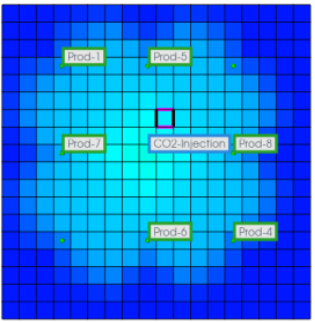
This study examines how the continuous CO2 injection method can improve oil recovery based on well patterns and injection volumes. The increase in oil recovery is observed using a number of well pattern scenarios, each with injection volume sensitivity. CMG-GEM is the software used in this study to simulate the different scenarios. A homogeneous reservoir model, grid data, reservoir fluid data, and reservoir data are among the data needed for this study. Four-spot, five-spot, nine-spot well patterns are taken into consideration in this research scenario. For each well pattern` the injection volumes that will subsequently be used as a reference for the injection rate at the injection well are one HCPV, five HCPV, ten HCPV, and twenty HCPV. According to the study’s findings, the inverted nine-spot well pattern with an injection volume of twenty HCPV scenario improves oil recovery more than the four-spot, five-spot and nine-spot well patterns.
Downloads
References
Dong, X., Liu, Y., Zhao, Y. and Wei, X. (2019) ‘A review of CO₂ solubility in oil and brine under reservoir conditions’, Energy & Fuels, 33(10), pp. 9577–9593.
Green, D.W. and Willhite, G.P. (2003) Enhanced oil recovery. SPE Textbook Series, Vol. 6. Richardson, TX: Society of Petroleum Engineers.
Hartono, K. et al. (2019) ‘Determination of CO₂ volume injection effect to reservoir fluid characteristics in miscible CO₂ displacement’, Journal of Physics: Conference Series, 1402, 055014. doi:10.1088/1742-6596/1402/5/055014.
Kaesti, E.Y. and Bintarto, B. (2017) ‘Peningkatan perolehan minyak dengan CO₂ flooding pada lapangan “X” lapisan “Y”’, Jurnal Mineral, Energi dan Lingkungan, 1(1), pp. 1–7. doi:10.31315/jmel.v1i1.1768.
Lake, L.W. (2010) Enhanced oil recovery. 2nd edn. Upper Saddle River, NJ: Prentice Hall.
Liu, D. and Sun, J. (2017) The control theory and application for well pattern optimization of heterogeneous sandstone reservoirs. Berlin: Springer-Verlag. doi:10.1007/978-3-662-53287-4.
Oktaviani, A.P.P. and Mucharam, L. (2020) ‘Optimization of surfactant flooding on BJG field using dynamic pattern’, PETRO: Jurnal Ilmiah Teknik Perminyakan, 9(2), pp. 52–63. doi:10.25105/petro.v9i2.6984.
Sugihardjo and Purnomo, H. (2009) ‘Perubahan sifat-sifat fluida reservoir pada injeksi CO₂’, Lembaran Publikasi Lemigas, 43(1), pp. 11–16. doi:10.29017/LPMGB.43.1.122.
Usman (2011) ‘Potensi pengembangan EOR untuk peningkatan produksi minyak Indonesia’, Lembaran Publikasi Minyak dan Gas Bumi, 45(2), pp. 91–102. doi:10.29017/LPMGB.45.2.687.
Zhang, L. et al. (2023) ‘Feasibility of advanced CO₂ injection and well pattern adjustment to improve oil recovery and CO₂ storage in tight-oil reservoirs’, Processes, 11, 3104. doi:10.3390/pr11113104
Downloads
Published
Issue
Section
License
Copyright (c) 2026 Journal of Geoscience, Engineering, Environment, and Technology

This work is licensed under a Creative Commons Attribution-ShareAlike 4.0 International License.
Copyright @2019. This is an open-access article distributed under the terms of the Creative Commons Attribution-ShareAlike 4.0 International License which permits unrestricted use, distribution, and reproduction in any medium. Copyrights of all materials published in JGEET are freely available without charge to users or / institution. Users are allowed to read, download, copy, distribute, search, or link to full-text articles in this journal without asking by giving appropriate credit, provide a link to the license, and indicate if changes were made. All of the remix, transform, or build upon the material must distribute the contributions under the same license as the original.