
Design of an Integrated Aircraft Fuel Ordering Based on Blockchain Technology at an International Airport
DOI:
https://doi.org/10.25299/jgeet.2025.10.1.1.24366Keywords:
aircraft fuel, blockchain technology, booking integration, supply chainAbstract
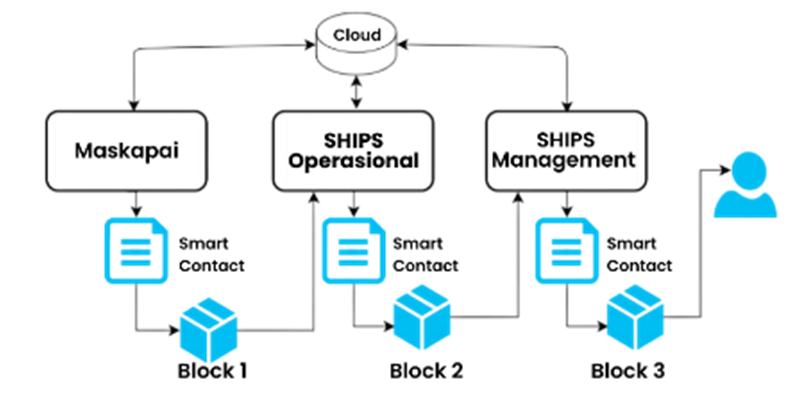
This study focuses on DPPU SHIPS. DPPU SHIPS is a subsidiary of PT Pertamina, which is a subsidiary of Pertamina that plays a role in the distribution and sale of aircraft fuel at Soekarno Hatta International Airport. Since 2020, Pertamina has been committed to digitizing all lines of business for efficiency. Therefore, the Digital Ground Operation (DGO) system was implemented, which combines the main business processes into one digital platform. In its implementation, weaknesses were found due to the absence of an integrated ordering system without intermediaries between airlines and Pertamina, resulting in a line of work that was prone to human error. This research aims to recommend an integrated service model for aircraft fuel distribution using blockchain technology. The booking system model is designed to ensure transparency of booking data and secure and valid receipt between airlines and Pertamina. Blockchain technology was chosen because it can guarantee transparency of orders, traceability, and the capacity to share information about the aircraft fuel distribution process. Thus, the aviation fuel supply chain can be more reliable. Furthermore, this technology can reduce human error in every transaction. The application of blockchain can revolutionize the way the supply chain works. This research consists of three stages: identifying the business processes of aviation fuel sales, identifying the data needed and used in each process along with the actors involved, and then formulating a model or design. The results of this research describe the model design of how the aircraft fuel ordering system is integrated by applying blockchain technology.
Downloads
References
Abdirad, M. and Krishnan, K. (2020) Industry 4.0 in logistics and supply chain management: A systematic literature review, Engineering Management Journal, pp. 1–15. doi:10.1080/10429247.2020.1783935.
Airport Service, J. (2023) PT. Jasa Angkasa Semesta – Company profile.
Androulaki, E. et al. (2018) Hyperledger Fabric: A distributed operating system for permissioned blockchains, in Proceedings of the 13th EuroSys Conference (EuroSys 2018). doi:10.1145/3190508.3190538.
Creswell, J.W. (2014) Research design: Qualitative, quantitative, and mixed methods approaches, 4th edn. California: Sage Publications.
Ebits (2023) Global aviation refuelling solutions.
Farouk, A., Alahmadi, A., Ghose, S. and Mashatan, A. (2020) Blockchain platform for industrial healthcare: Vision and future opportunities, Computer Communications, 154, pp. 223–235. doi:10.1016/j.comcom.2020.02.058.
Helo, P. and Hao, Y. (2019) Blockchains in operations and supply chains: A model and reference implementation, Computers & Industrial Engineering, 136, pp. 242–251. doi:10.1016/j.cie.2019.07.023.
Hyperledger (2023) What is Hyperledger Fabric?
IATA (2015) IATA guidance material for sustainable aviation fuel management, 2nd edn. Montreal: International Air Transport Association.
Indonesia, G. (2023) Gapura Angkasa – Airport service.
Liu, J., Yan, L. and Wang, D. (2022) A hybrid blockchain model for trusted data of supply chain finance, Wireless Personal Communications, pp. 919–943. doi:10.1007/s11277-021-08451-x.
Nanayakkara, S. et al. (2021) Blockchain and smart contracts: A solution for payment issues in construction supply chains, Informatics, 8(2), p. 36. doi:10.3390/informatics8020036.
Pertamina One Solution (2021) Digital ground operation (DGO): Inovasi refueling Pertamina.
Pertamina Patra Niaga (2023) Vision and mission.
Radziwill, N. (2018) Blockchain revolution: How the technology behind Bitcoin is changing money, business, and the world, Quality Management Journal, 25(1), pp. 64–65. doi:10.1080/10686967.2018.1404373.
Rcapodieci (2023) How peer-to-peer networks can improve supply chain management.
Tumpal, A., Sianturi, L. and Oklilas, A.F. (2022) Penerapan teknologi blockchain pada sistem supply chain management yang terintegrasi dengan sensor RFID (paper review), Jurnal Sistem Informasi (JSI), 14(1). doi:10.18495/jsi.v14i1.17129.
Vikaliana, R. et al. (2024) Sustainable supply chain in carbon emissions assessment with blockchain technology driven: A framework for mining industries, IOP Conference Series: Earth and Environmental Science, 1422(1), pp. 1–6. doi:10.1088/1755-1315/1422/1/012029.
Vincent, N.E., Skjellum, A. and Medury, S. (2020) Blockchain architecture: A design that helps CPA firms leverage the technology, International Journal of Accounting Information Systems, 38. doi:10.1016/j.accinf.2020.100466.
Zhang, X. et al. (2020) Blockchain-based safety management system for the grain supply chain, IEEE Access, 8, pp. 36398–36410. doi:10.1109/ACCESS.2020.2975415.
Zhu, X. (2019) Application of blockchain technology in energy internet market and transaction, IOP Conference Series: Materials Science and Engineering, 592(1). doi:10.1088/1757-899X/592/1/012159.
Zhu, X. and Wang, D. (2019) Research on blockchain application for e-commerce, finance and energy, IOP Conference Series: Earth and Environmental Science, 252(4). doi:10.1088/1755-1315/252/4/042126.
Downloads
Published
Issue
Section
License
Copyright (c) 2026 Journal of Geoscience, Engineering, Environment, and Technology

This work is licensed under a Creative Commons Attribution-ShareAlike 4.0 International License.
Copyright @2019. This is an open-access article distributed under the terms of the Creative Commons Attribution-ShareAlike 4.0 International License which permits unrestricted use, distribution, and reproduction in any medium. Copyrights of all materials published in JGEET are freely available without charge to users or / institution. Users are allowed to read, download, copy, distribute, search, or link to full-text articles in this journal without asking by giving appropriate credit, provide a link to the license, and indicate if changes were made. All of the remix, transform, or build upon the material must distribute the contributions under the same license as the original.


