Estimation of Aspect Ratio Values in Carbonate Rocks Using the Kuster–Toksöz Model for Reservoir Characterization
DOI:
https://doi.org/10.25299/jgeet.2025.10.1.1.24354Keywords:
carbonate reservoir, inclusion model, Kuster ToksӧzAbstract
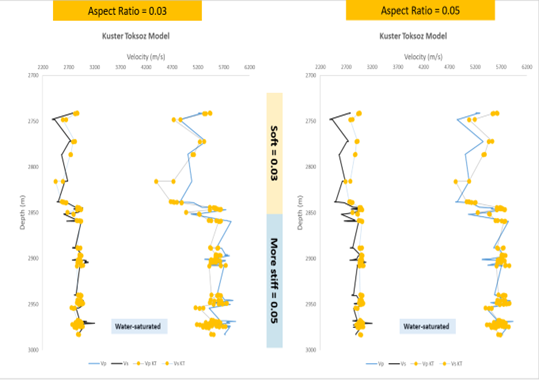
Carbonate reservoirs are known for their complex pore structures, which significantly affect their elastic properties and, consequently, their fluid storage and flow capacities. Traditional models often fail to capture the heterogeneous pore geometries in carbonate rocks accurately. The Kuster-Toksöz model offers a means to estimate effective elastic moduli by incorporating pore aspect ratios, providing a more nuanced understanding of pore shapes and distributions The combination of Kuster Toksӧz inclusion model for pore shape of penny cracks produces velocity model which is then compared with the measurement results. The results show a good match at 2800 m - 3000 m intervals with a single aspect ratio of 0.05. The difference in the aspect ratio of each depth is related to the compacting process of rock formation due to increased depth, which shows that the deeper the depth the rock pore will be stiffer.
Downloads
References
Hilman, J. and Winardhi, I.S., 2019. Rock physics template application on carbonate reservoir. IOP Conference Series: Earth and Environmental Science, 318, 012006. doi:10.1088/1755-1315/318/1/012006
Kuster, G.T. and Toksöz, M.N., 1974. Velocity and attenuation of seismic waves in two-phase media: Part I. Theoretical formulations. Geophysics, 39(5), pp.587–606. doi:10.1190/1.1440450
Li, B., Shen, H., Qu, S., Wang, D. and Liu, C., 2018. Rock physics modeling and elastic parameter analysis of carbonate reservoirs. Journal of Applied Geophysics, 159, pp.374–385. doi:10.1016/j.jappgeo.2018.09.012
Liu, Z., Dong, N., Wang, Z., Liu, J. and Shi, L., 2020. S-wave velocity estimation using Kuster–Toksöz rock physics model optimized by QPSO algorithm for organic-rich shales. EAGE 2020 Annual Conference & Exhibition Online, 2020, pp.1–5. doi:10.3997/2214-4609.202011031
Mavko, G., Mukerji, T. and Dvorkin, J., 2009. The Rock Physics Handbook. 2nd ed. New York: Cambridge University Press. doi:10.1017/CBO9780511626753
Schön, J.H., 2011. Physical Properties of Rocks. Vol. 8. Amsterdam: Elsevier.
Wang, Z., 1997. Seismic properties of carbonate rocks: Pore shape and porosity effects. In: SEG (ed.) Handbook of Geophysics, Chapter 3. Tulsa: Society of Exploration Geophysicists.
Zhao, L., Nasser, M. and Han, D., 2013. Rock physics modeling of carbonate reservoirs. Geophysical Prospecting, 61, pp.827–841. doi:10.1111/1365-2478.12043
Zimmermann, R.W., 1991. Compressibility of Sandstones. New York: Elsevier
Downloads
Published
Issue
Section
License
Copyright (c) 2026 Journal of Geoscience, Engineering, Environment, and Technology

This work is licensed under a Creative Commons Attribution-ShareAlike 4.0 International License.
Copyright @2019. This is an open-access article distributed under the terms of the Creative Commons Attribution-ShareAlike 4.0 International License which permits unrestricted use, distribution, and reproduction in any medium. Copyrights of all materials published in JGEET are freely available without charge to users or / institution. Users are allowed to read, download, copy, distribute, search, or link to full-text articles in this journal without asking by giving appropriate credit, provide a link to the license, and indicate if changes were made. All of the remix, transform, or build upon the material must distribute the contributions under the same license as the original.