
Groundwater Potential in The Confined Aquifer Cibeureum Formation Using the Jacob Method Pump Test, Bandung – Soreang Groundwater Basin, Bandung City, West Java Province
DOI:
https://doi.org/10.25299/jgeet.2025.10.1.1.24305Keywords:
groundwater subsidence, Cibeureum Formation, confined aquiferAbstract
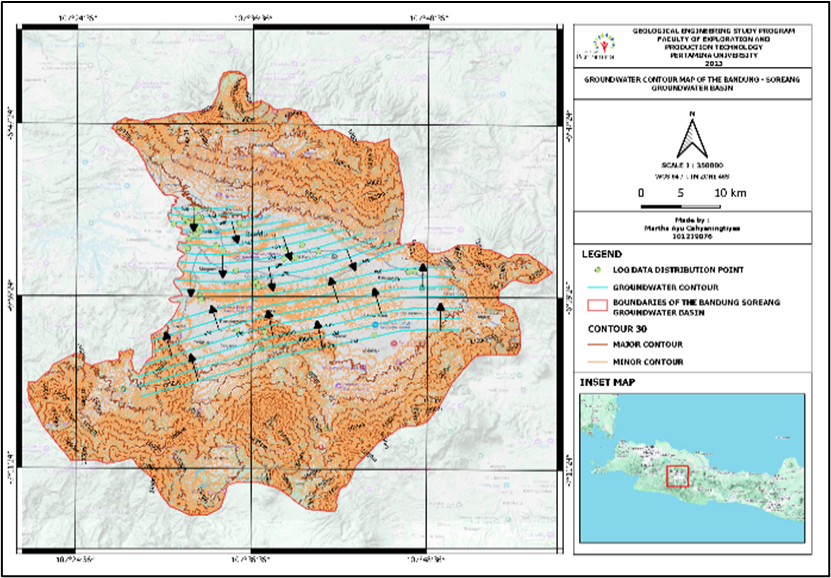
High population growth increases demand for clean water. The greater the demand for clean water, the greater the extraction of groundwater. This large-scale extraction of groundwater is not balanced with the rate of groundwater recharge in aquifers, resulting in a decline in the water table. Groundwater subsidence is an ongoing problem in some areas of Indonesia, especially in densely populated areas. Bandung is one of the areas experiencing a decline in groundwater levels. The confined aquifer in the Cibeureum Formation of the Bandung-Soreang Groundwater Basin is one of the aquifers that is a source of clean water for the people of Bandung. Currently, the groundwater level in the aquifer continues to decline. The amount of potential groundwater discharge in this basin must be known, to limit the amount of groundwater withdrawal. This study aims to determine the amount of groundwater reserves, and ways to reduce the decline in groundwater levels in the basin. In this research, pumping test well data is used, which will be processed using the Jacob Method to obtain the value of groundwater reserves in the Bandung-Soreang Groundwater Basin. The amount of groundwater reserves in this basin is 67.50 L/sec. Meanwhile, the amount of groundwater is 43.87 L/sec.
Downloads
References
Charly, V., Sujatmoko, B. and Sandhyavitri, A. (2017) Analisis karakteristik hidraulis air tanah gambut berdasarkan uji pemompaan (pumping test). Jurnal Online Mahasiswa (JOM) Bidang Teknik dan Sains, 4(1), pp. 1–9.
Katili, J.A. (1975) Volcanism and plate tectonics in the Indonesia island arcs. Tectonophysics, 26(3–4), pp. 165–188. doi:10.1016/0040-1951(75)90088-8.
Kruseman, G.P., De Ridder, N.A. and Verweij, J.M. (1994) Analysis and evaluation of pumping test data. Wageningen: International Institute for Land Reclamation and Improvement.
Lesmana, A., CSSSA, B.Y. and Iskandarsyah, T.Y.W.M. (2021) Karakteristik hidrokimia air tanah pada bagian timur cekungan air tanah Bandung–Soreang: studi kasus sebagian Kecamatan Cicalengka dan Kecamatan Cimanggung, Provinsi Jawa Barat. Padjadjaran Geoscience Journal, 5(6), pp. 546–561.
Nadhowi, M.A., Syamsuddin, Kusnadi and Wijaya, A. (2022) Identifikasi akuifer air tanah dengan metode geolistrik resistivitas konfigurasi Schlumberger untuk pengembangan irigasi persawahan di Dusun Tampak Siriring, Mantang. Jurnal Pertambangan dan Lingkungan, 3(2), pp. 20–27. doi:10.31764/jpl.v3i2.13601.
Narulita, I., Rahmat, A. and Maria, R. (2008) Aplikasi sistem informasi geografi untuk menentukan daerah prioritas rehabilitasi di Cekungan Bandung. Geology and Mining Research, 18(1), pp. 23–35. doi:10.14203/risetgeotam2008.v18.9.
Purwoarminta, A., Lubis, R.F. and Maria, R. (2019) Artificial recharge for Bandung–Soreang groundwater basin conservation. Geology and Mining Research, 29(1), pp. 65–73. doi:10.14203/risetgeotam2019.v29.1004.
Sikdar, P.K. (2019) Pumping test for aquifers: analysis and evaluation. In: Groundwater development and management. Cham: Springer, pp. 267–277. doi:10.1007/978-3-319-75115-3_11.
Tohari, A., Soebowo, E., Wibawa, S. and Arifan, J.S. (2015) Kondisi geologi teknik bawah permukaan wilayah Cekungan Bandung (lintasan Gedebage–Bojongsoang–Solokanjeruk–Majalaya). Prosiding Geoteknologi LIPI.
Wibowo, M. (2005) Kajian atas hasil-hasil penelitian kawasan konservasi daerah resapan air di Cekungan Bandung. Jurnal Teknologi Lingkungan BPPT, 6(3). doi:10.29122/jtl.v6i3.35424.
Downloads
Published
Issue
Section
License
Copyright (c) 2025 Journal of Geoscience, Engineering, Environment, and Technology

This work is licensed under a Creative Commons Attribution-ShareAlike 4.0 International License.
Copyright @2019. This is an open-access article distributed under the terms of the Creative Commons Attribution-ShareAlike 4.0 International License which permits unrestricted use, distribution, and reproduction in any medium. Copyrights of all materials published in JGEET are freely available without charge to users or / institution. Users are allowed to read, download, copy, distribute, search, or link to full-text articles in this journal without asking by giving appropriate credit, provide a link to the license, and indicate if changes were made. All of the remix, transform, or build upon the material must distribute the contributions under the same license as the original.


