Improvement of Earthquake Source Mechanism Using Waveform Inversion in the Indo-Australian Oceanic Plate
DOI:
https://doi.org/10.25299/jgeet.2026.11.1.24276Keywords:
Indo-Australian Plate, waveform inversion, Grond, earthquake parameters, focal mechanismAbstract
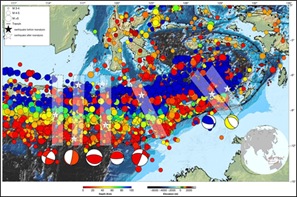
The Indo-Australian Oceanic Plate region is an active and complex subduction zone. Tectonic activity in this area generates various types of faults, including thrust, strike-slip, and normal faults, reflecting the dynamic deformation of the lithosphere. This study aims to refine earthquake source parameters using waveform inversion based on the Bayesian Bootstrap approach. Seven earthquake events with magnitudes greater than 5, occurring between 2010 and 2025, were analyzed to obtain more accurate parameters, including location, depth, origin time, duration, magnitude, and fault plane orientation (strike, dip, and slip). Waveform data were retrieved from the USGS catalog and processed using the Grond and Pyrocko software. The inversion results indicate significant shifts in initial parameters, with misfit values below 0.5, demonstrating a high level of agreement between synthetic and observed waveforms. The tectonic interpretation of the inversion outcomes reveals a relationship between hypocenter depth, fault type, and subduction zone geometry. This research is expected to contribute to a better understanding of earthquake source mechanisms and serve as a scientific reference for disaster mitigation efforts in the Indo-Australian Plate region.
Downloads
References
Alif, A. F., Nugroho, H., & Widiyantoro, S. (2021). Post- seismic deformation analysis following the 2016 Indian Ocean earthquake using GNSS data in western Indonesia. Geophysical Research: Solid Earth, 126(4), E2020JB020765.
Alif, S.M., Anggara, O., Perdana, R.S., Hasannah, U. & Azizah, F.N. (2024) ‘Analysis of presumed land subsidence in the cities of Lampung Province using InSAR and GNSS data’, Journal of Geoscience, Engineering, Environment, and Technology, 9(3), pp. 255–261.
Amad, R., Hansen, T.M., Jakobsen, M. & Chapman, M. (2020) On the full-waveform inversion of seismic moment tensors. Computers & Geosciences, 140, 104505.
Cesca, S., Heimann, S., Rivalta, E. and Dahm, T. (2017) ‘Automated moment tensor inversion and earthquake characterization using probabilistic methods’, Seismological Research Letters, 88(5), pp. 1482–1491.
DeMets, C., Gordon, R. G., & Argus, D. F. (2010). Geologically current plate motions. Geophysical Journal International, 181(1), 1–80.
Frohlich, C. (2001). Display and quantitative assessment of distributions of earthquake focal mechanisms. Geophysical Journal International, 144(2), 300–308.
Gibbons, A. D., Zahirovic, S., Müller, R. D., Whittaker, J. M., Yatheesh, V., & Lado-Insua, T. (2015). A tectonic model reconciling evidence for the collisions between India, Eurasia and intra-oceanic arcs of the central-eastern Tethys. Gondwana Research, 28(2), 451–492.
Gu, C., Toksöz, M. N. & Marzouk, Y. (2018) Waveform-based Bayesian full moment tensor inversion and uncertainty determination for the induced seismicity in an oil/gas field. Geophysical Journal International, 212(3), pp. 1963–1985.
Hall, R. (2002). Cenozoic geological and plate tectonic evolution of SE Asia and the SW Pacific. Journal of Asian Earth Sciences, 20(4): 353–431.
Harris, R. A. (2021). ifting and collision in the Banda Arc: The transition from subduction to arc-continent collision. Geological Society, London, Special Publications, 532(1), 1–35.
Heimann, S., Isken, M., Kühn, D., Sudhaus, H., Steinberg, A., Daout, S., Cesca, S., Vasyura-Bathke, H. & Dahm, T. (2018) Grond – A probabilistic earthquake source inversion framework. GFZ Data Services.
Heimann, S., Vasyura-Bathke, H., Sudhaus, H., Isken, M., Kriegerowski, M., Steinberg, A. & Dahm, T. (2019) ‘A Python framework for efficient use of pre-computed Green’s functions in seismological and other physical forward and inverse source problems’, Solid Earth, 10(6), pp. 1921–1935.
Hidayati, S. (2010). Pengantar Seismologi Gempabumi. Badan Pengkajian dan Penerapan Teknologi (BPPT).
H Simanjuntak and Muksin Umar, A. V. (2018). Analisis Mekanisme Fokal Menggunakan Inversi Waveform; Studi Kasus Gempa Bumi Pidie Jaya 7 Desember 2016. J. Aceh Phys. Soc, 7(3), 127–132.
Irwandi, Z., Zulfakriza, Muzli, Hassan, H.M. & Okubo, M. (2025) ‘Seismic Hazard for Regional-Scale Sumatra Island Based on Realistic Physical Computation of Seismic Wave Propagation’, Journal of Geoscience, Engineering, Environment, and Technology, 10(2).
Khalqillah, A., Umar, M., Simanjuntak, A.V.H., Jihad, A. & Banyunegoro, V.H. (2025) ‘Seismic Hazard Estimation for Sumatra and Kalimantan Region Using Event-Based Probabilistic Seismic Hazard Analysis (EB-PSHA)’, Journal of Geoscience, Engineering, Environment, and Technology, 10(3), pp. 329–337.
Lubis, A. M., Subarya, C., Meilano, I., & Nugraha, A. D. (2020). Re-evaluation of the Indo-Australian Plate motion using 23 years of GPS observations (1994–2016). Geoscience Letters, 7(1), 12.
McCaffrey, R. (2009). The tectonic framework of the sumatran subduction zone. Annual Review of Earth and Planetary Sciences, 37(November 2008), 345–366.
Müller, R. D., Zahirovic, S., Williams, S. E., Cannon, J., Seton, M., Bower, D. J., Tetley, M. G., Heine, C., Le Breton, E.,Liu, S., Russell, S. H. J., Yang, T., Leonard, J., & Gurnis, M. (2019). A Global Plate Model Including Lithospheric Deformation Along Major Rifts and Orogens Since the Triassic. Tectonics, 38(6), 1884– 1907.
Petersen, G. M., Cesca, S., Heimann, S., Niemz, P., Dahm, T., Kühn, D., Kummerow, J., & Plenefisch, T. (2021). Regional centroid moment tensor inversion of small to moderate earthquakes in the Alps using the dense AlpArray seismic network: Challenges and seismotectonic insights. Solid Earth, 12(6), 1233–1257.
Petersen, M.D., Dewey, J., Hartzell, S., Mueller, C., Harmsen, S., Frankel, A.D. and Rukstales, K. (2004) ‘Probabilistic seismic hazard analysis for Sumatra, Indonesia and across the Southern Malaysian Peninsula’, Tectonophysics, 390(1-4), pp. 141–158.
Qadariyah, Q., Simanjuntak, A. V. H. & Umar, M. (2018). Analysis of Focal Mechanisms Using Waveform Inversion; Case Study of Pidie Jaya Earthquake December 7, 2016. Journal of Aceh Physics Society, 7(3)
Reynolds, J. M. (2011). An Introduction to Applied and Environmental Geophysics. In European Space Agency, (Special Publication) ESA SP (2nd Editio, Issue 606). John Wiley & Sons, Ltd.
Shearer, P. M. (2009). Introduction to Seismology (2nd ed.). Cambridge : Cambridge University Press, New York.
Stein, S. and M. W. (2003). An Introduction to Seismology, Earthquakes, and Earth Structure. Blackwell Publishing Utd. United Kingdom.
Stern, R. . (2002). Subduction zones. Reviews of Geophysics, 40(4), 3–1–3-38.
Sunarjo, D. (2012). Gempabumi Edisi Populer. Jakarta, BMKG.
Tregoning, P., Lambeck, K., Stolz, A., Morgan, P., McClusky, S. C., Van Der Beek, P., McQueen, H., Jackson, R. J., Little, R. P., Laing, A., & Murphy, B. (1998). Estimation of current plate motions in Papua New Guinea from Global Positioning System observations. Journal of Geophysical Research: Solid Earth, 103(6), 12181– 12203.
Van Hinsbergen, D. J. J., Steinberger, B., Doubrovine, P. V., & Gassmöller, R. (2018). cceleration and deceleration of India–Asia convergence since the Cretaceous: Roles of mantle plumes and continental collision. Nature Geoscience, 11, 516–521.
Wang, K., Hu, Y., & He, J. (2012). Deformation cycles of subduction earthquakes in a viscoelastic Earth. Nature, 484(7394), 327–332.
Downloads
Published
Issue
Section
License
Copyright (c) 2026 Journal of Geoscience, Engineering, Environment, and Technology

This work is licensed under a Creative Commons Attribution-ShareAlike 4.0 International License.
Copyright @2019. This is an open-access article distributed under the terms of the Creative Commons Attribution-ShareAlike 4.0 International License which permits unrestricted use, distribution, and reproduction in any medium. Copyrights of all materials published in JGEET are freely available without charge to users or / institution. Users are allowed to read, download, copy, distribute, search, or link to full-text articles in this journal without asking by giving appropriate credit, provide a link to the license, and indicate if changes were made. All of the remix, transform, or build upon the material must distribute the contributions under the same license as the original.