
Corrosion Rate Analysis in Material Selection for Tubing in CO2 Injection Process at Well K-28
DOI:
https://doi.org/10.25299/jgeet.2025.10.1.1.24168Keywords:
CO2 Injection, Corrosion, Material SelectionAbstract
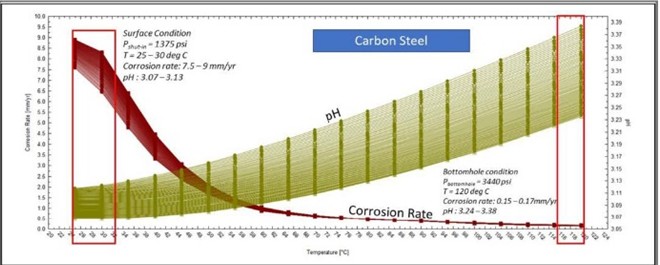
This research aims to analyze the corrosion level of the tubing material used in CO2 injection at well K-28. Four types of carbon steel tubing, 13Cr, super 13Cr, and super 15Cr, were analyzed under shut-in and injection conditions using experimental data from a previously published paper titled “Material Selection and Corrosion Rate Analysis for CO2 Injection Well: A Case Study of K1 Field CO2 Sequestration Project”. The research results in eight corrosion rate equations for each condition and type of tubing. Based on the analysis, super 15Cr shows the best corrosion resistance, both in shut-in and injection conditions, with a corrosion rate ranging from 0.00053 mm/year to 0.00085 mm/year at temperatures of 25-35°C and pH 3.08-3.09. The research also showed that the temperature from the surface to the bottom hole and pH had a significant impact on the corrosion rate. Data was processed using Excel and StatsModels library of Python machine learning to estimate the corrosion rate based on these parameters. Super 15Cr is recommended as the most corrosion-resistant tubing material for use in high corrosion potential environments during the CO2 injection process in well K-28. This conclusion is based on a combination of literature studies, experiments, and regression analysis, which identify super 15Cr as the optimal choice for minimizing corrosion risk in this application.
Downloads
References
Abd, A.A., Naji, S.Z. and Hashim, A.S., 2019. Failure Analysis of Carbon Dioxide Corrosion Through Wet Natural Gas Gathering Pipelines. Engineering Failure Analysis, 105, pp.638–646. doi:10.1016/j.engfailanal.2019.07.026.
Bakar, M.A.A., Mohamad, W.A.W., Wahi, M.W.M. and Amir, M.S.E., 2021. Material Selection and Corrosion Rate Analysis for CO₂ Injection Well: A Case Study of K1 Field CO₂ Sequestration Project. International Petroleum Technology Conference (IPTC 2021), pp.1–19. doi:10.2523/IPTC-21818-MS.
Bulyarskiǐ, S.V. and Prikhod'ko, V.V., 1999. Chemical Potential of a Binary Solution. Technical Physics Letters, 25, pp.263–264. doi:10.1134/1.1262447.
Fontana, M.G., 1986. Corrosion Engineering. 3rd ed.
Revie, R.W. and Uhlig, H.H., 2008. Definition and Importance of Corrosion. In: Corrosion and Corrosion Control, pp.1–8. doi:10.1002/9780470277270.ch1.
Roberge, P.R., 2000. Handbook of Corrosion Inhibitors. The McGraw-Hill Companies, Inc. doi:10.1016/S0026-0576(00)83445-5.
Downloads
Published
Issue
Section
License
Copyright (c) 2026 Journal of Geoscience, Engineering, Environment, and Technology

This work is licensed under a Creative Commons Attribution-ShareAlike 4.0 International License.
Copyright @2019. This is an open-access article distributed under the terms of the Creative Commons Attribution-ShareAlike 4.0 International License which permits unrestricted use, distribution, and reproduction in any medium. Copyrights of all materials published in JGEET are freely available without charge to users or / institution. Users are allowed to read, download, copy, distribute, search, or link to full-text articles in this journal without asking by giving appropriate credit, provide a link to the license, and indicate if changes were made. All of the remix, transform, or build upon the material must distribute the contributions under the same license as the original.


