Performance Comparison of Isolation Forest and COPOD Algorithms for Anomaly Detection in Electrical Submersible Pumps
DOI:
https://doi.org/10.25299/jgeet.2025.10.1.1.23849Keywords:
Electrical Submersible Pump (ESP), Anomaly Detection, Isolation Forest, Copula-based Outlier Detection, Machine LearningAbstract
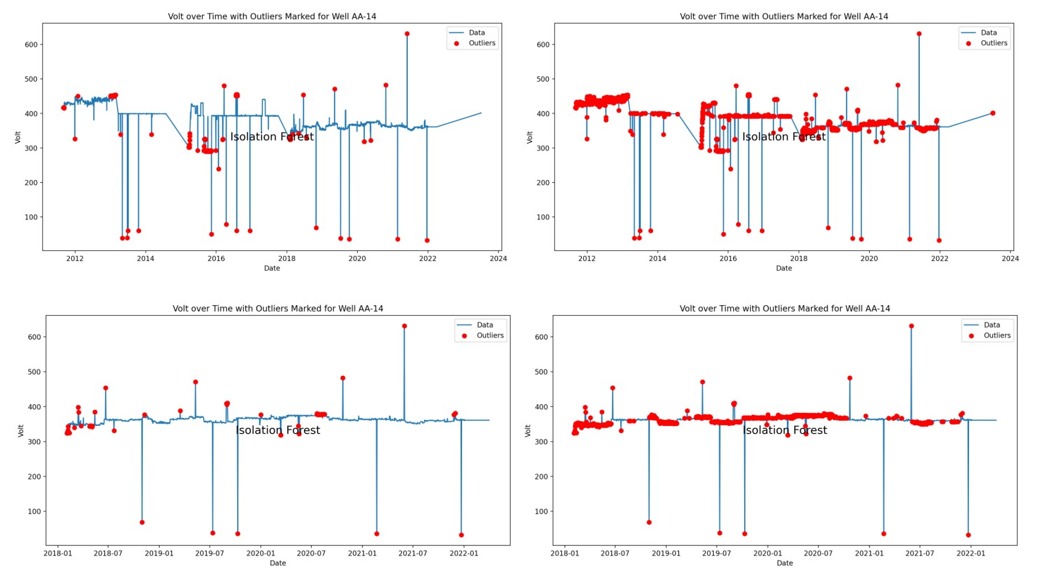
The Electrical Submersible Pump (ESP) is a crucial technology in enhancing oil production, yet its performance can be compromised by anomalies that lead to operational disruptions and financial losses. Early detection of these anomalies is vital for minimizing risks and optimizing ESP lifespan. This study compares the performance of two machine learning algorithms—Isolation Forest and Copula-Based Outlier Detection (COPOD)—in identifying anomalies in ESP operational data. The study uses both long-term historical data and short-term period data from a well in Field X, focusing on key operational parameters such as amperes, frequency, voltage, discharge pressure, motor temperature, vibration, and gross rate. The results indicate that Isolation Forest outperforms COPOD in detecting anomalies, particularly in the presence of missing data. Short-term data detection yields clearer correlations between anomalies in different features, highlighting its advantage over long-term historical data. The findings underscore the importance of utilizing short-term operational data and demonstrate how anomaly detection algorithms can enhance ESP monitoring for improved performance and cost-efficiency.
Downloads
References
Abdalla, R., Samara, H., Perozo, N., Carvajal, C.P. and Jaeger, P., 2022. Machine learning approach for predictive maintenance of the electrical submersible pumps (ESPs). ACS Omega, 7(21), pp.17641–17651.
Al Maghlouth, A., Cumings, M., Al Awajy, M. and Amer, A., 2013. ESP surveillance and optimization solutions: Ensuring best performance and optimum value. Presented at: SPE Middle East Oil and Gas Show and Conference, Manama, Bahrain.
Amer, M., Goldstein, M. and Abdennadher, S., 2013. Enhancing one-class support vector machines for unsupervised anomaly detection. Proceedings of the ACM SIGKDD Workshop on Outlier Detection and Description, pp.8–15.
Bhardwaj, A.S., Saraf, R., Nair, G.G. and Vallabhaneni, S., 2020. Real-time monitoring and predictive failure identification for electrical submersible pumps. Presented at: SPE Russian Petroleum Technology Conference.
Chandola, V., Banerjee, A. and Kumar, V., 2009. Anomaly detection. Computing in Science & Engineering, 14(1), pp.1–22.
Ding, Z. and Fei, M., 2013. An anomaly detection approach based on isolation forest algorithm for streaming data using sliding window. IFAC Proceedings Volumes
Guo, D., Raghavendra, C.S., Yao, K.T., Harding, M., Anvar, A. and Patel, A., 2015. Data driven approach to failure prediction for electrical submersible pump systems. Presented at: SPE Western Regional Meeting, pp.967–972.
Gupta, S., Saputelli, L. and Nikolaou, M., 2016. Big data analytics workflow to safeguard ESP operations in real-time. Presented at: SPE North America Artificial Lift Conference and Exhibition, 25–27 October.
Jansen van Rensburg, N., 2018. Usage of artificial intelligence to reduce operational disruptions of ESPs by implementing predictive maintenance. Presented at: Abu Dhabi International Petroleum Exhibition & Conference.
Liang, X., Duan, F., Bennett, I. and Mba, D., 2020. A sparse autoencoder-based unsupervised scheme for pump fault detection and isolation. Applied Sciences, 10(19), p.6789.
Liu, D., Feng, G., Feng, G. and Xie, L., 2024. Hybrid long short- term memory and convolutional neural network architecture for electric submersible pump condition prediction and diagnosis. SPE Journal, 29(5), pp.2130–2147.
Sherif, S., Adenike, O., Obehi, E., Funso, A. and Eyituoyo, B.,
2019. Predictive data analytics for effective electric submersible pump management. Presented at: SPE Nigeria Annual International Conference and Exhibition. doi:10.2118/198759-MSs
Shuwaikhat, H.A., Ramos, M., Aifan, A.-R. and Al-Sadah, A.A., 2017. Innovative approach to prolong ESP run life using algorithmic models. Presented at: Abu Dhabi International Petroleum Exhibition & Conference, Abu Dhabi, UAE.
Sneed, J., 2017. Predicting ESP lifespan with machine learning. Presented at: SPE/AAPG/SEG Unconventional Resources Technology Conference, pp.863–869.
Song, Y., Jun, S., Nguyen, T.C. and Wang, J., 2024. Experimental data-driven model development for ESP failure diagnosis based on the principal component analysis. Journal of Petroleum Exploration and Production Technology, 14(6), pp.1521–1537.
Takacs, G., 2009. Electrical Submersible Pumps Manual. Oxford: Gulf Professional Publishing.
Zhu, D., Wang, X., Chen, H. and Wu, R., 2014. Semi- supervised support vector machines regression. Proceedings of the 2014 9th IEEE Conference on Industrial Electronics and Applications (ICIEA), pp.2015–2018.
Downloads
Published
Issue
Section
License
Copyright (c) 2026 Journal of Geoscience, Engineering, Environment, and Technology

This work is licensed under a Creative Commons Attribution-ShareAlike 4.0 International License.
Copyright @2019. This is an open-access article distributed under the terms of the Creative Commons Attribution-ShareAlike 4.0 International License which permits unrestricted use, distribution, and reproduction in any medium. Copyrights of all materials published in JGEET are freely available without charge to users or / institution. Users are allowed to read, download, copy, distribute, search, or link to full-text articles in this journal without asking by giving appropriate credit, provide a link to the license, and indicate if changes were made. All of the remix, transform, or build upon the material must distribute the contributions under the same license as the original.