
Analysis Of Aquifer Characteristics Using The Method Cooper Jacob At Block X Pt. Geomine Bara Studio Site Kutai Kartanegara, East Kalimantan, Indonesia
DOI:
https://doi.org/10.25299/jgeet.2025.10.3.19690Keywords:
Aquifer, confined aquifer, Cooper-Jacob method, aquifer characteristics, pumping testAbstract
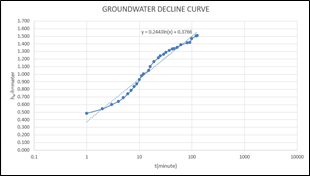
Using the Cooper-Jacob method, this research analyzes the characteristics of the aquifer in Block X of Geomine Bara Studio Site Ltd., Kutai Kartanegara. This method can determine the main hydrogeological parameters, such as the aquifer's hydraulic conductivity/permeability coefficient, transmissivity, and storage coefficient (storativity) of the aquifer. Data from the pumping test served to understand the aquifer's response to pumping. The research results showed that the aquifer in Block X had a transmissivity of 193,9949 m²/day, hydraulic conductivity of 6,0634335 m/day, and a storage coefficient (storativity) of 0,000137. The soil type at the test location was fine sandy with a low porosity value of n = 0,499%, and the soil permeability was low at k = 0,056403975 mm/ sec. Groundwater in the study area had quite potential for meeting the needs of Geomine Bara Studio Site Ltd in Kutai, Kartanegara, with a groundwater availability of H219,398 m³ and a withdrawal rate of Q 182,0678 m³/day. This study indicated high water flow capacity with low storage ability, suggesting a confined aquifer. It benefits sustainable groundwater management and mitigates environmental impacts in the study area.
Downloads
References
Abdul, A. (2013). Permodelan Hidrologi Mudah bagi Pasang Surut di Sungai Pulai, Johor. Universiti Teknologi Malaysia.
Alviyanda, Anjar Dwi Asterina, Redhatul Irma, 2023. Identification of Saltwater Intrusion Distribution in North Padang Cermin Area, Lampung, Indonesia. J. Geosci. Eng. Environ. Technol. 8, 281–287.
Bisri, M. (2012). Air Tanah. Universitas Brawijaya Press.
Cooper Jr, H. H., & Jacob, C. E. (1946). A Generalized Graphical Method for Evaluating Formation Constants and Summarizing Well‐Field History. Eos, Transactions American Geophysical Union, 27(4), 526–534.
Hardiyatmo, H. C. (2002). Mekanika Tanah I (3rd ed.). Gramedia Pustaka Utama.
Harjito, H. (2014). Metode Pumping Test sebagai Kontrol Untuk Pengambilan Air Tanah Secara Berlebihan. Jurnal Sains & Teknologi Lingkungan, 6(2), 138–149.
Johnson, A. I. (1967). Specific Yield: Compilation of Specific Yields for Various Materials (Issue 1662). US Government Printing Office.
Kodoatie, R. J. (2010). Tata Ruang Air Tanah. Penerbit Andi.
Linsley, R. K. (1979). The Hydrologic Services of the Weather Bureau. Weatherwise, 2(5), 105–109.
Linsley, R. K. (1994). The Relation Between Rainfall and Runoff. Journal of Hydrology, 5, 297–311.
Listiawan, Y., Suganda, N.B., Cipta, E., 2015. Kajian Potensi Intrusi Air Laut Berdasarkan Karakteristik Hidrokimia Airtanah Di Daerah Karangwuni Kecamatan Wates Kabupaten Kulon Progo Provinsi DI Yogyakarta, in: Seminar Nasional Ke-II FTG Universitas Padjadjaran.
Lohman, S. W. (1972). Ground-Water Hydraulics (Vol. 708). US Government Printing Office.
Morris, D. A., & Johnson, A. I. (1967). Summary of hydrologic and physical properties of rock and soil materials, as analyzed by the hydrologic laboratory of the U.S. Geological Survey, 1948-60. U.S. Geological Survey.
Moss, S. J., & Chambers, J. L. C. (1999). Tertiary Facies Architecture in the Kutai Basin, Kalimantan, Indonesia. Journal of Asian Earth Sciences, 17(1–2), 157–181.
Purnama, S. (2010). Hidrologi Air Tanah. Yogyakarta, DI Yogyakarta, Indonesia: Kanisius.
Putra, D.B.E., Yuskar, Y., Kausarian, H., Wan Yaacob, W.Z., Hadian, M.S.D., 2019. Saltwater Intrusion Zone Mapping on Shallow Groundwater Aquifer in Selat Baru, Bengkalis Island, Indonesia. J. Geosci. Eng. Environ. Technol. 4, 16.
Rahmawati, N., Vuillaume, J.F., Purnama, I.L.S., 2013. Salt intrusion in coastal and lowland areas of semarang city. J. Hydrol. 494, 146–159.
Riyadi, A. (2005). Identifikasi Potensi Air Tanah di Kecamatan Mangkubumi Tasikmalaya dengan Metode Uji Pompa. Jurnal Teknologi Lingkungan, 6(2).
Rizal, N. S., & Kuryanto, T. D. (2015). Teknik Pendugaan dan Kplotasi Air Tanah. LPPM Ummuh Jember.
Santosa, L.W dan Adji, T.N. (2014). Karakteristik Akuifer dan Potensi Air tanah Graben Bantul. Yogyakarta: Gadjah Mada University Press
Shiddiqy, M. H. (2014). Pemetaan Keberadaan Akuifer Menggunakan Metode Resistivitas Konfigurasi Schlumberger di Daerah Nanggulan, Kabupaten Kulonprogo, Provinsi Daerah Istimewa Yogyakarta. Universitas Gadjah Mada Press.
Sjarif, L. (2003). Penentuan Nilai Karakteristik Akuifer Sumur Air Tanah Melalui Uji Pemompaan (Pumping Test) Dengan Metode Cooper-Jacob di Leuwikopo, Darmaga. IPB (Bogor Agricultural University).
Supriatna, S., Sukardi, R., & Rustandi, E. (1995). Peta Geologi Lembar Samarinda, Kalimantan Timur. Pusat Penelitian Dan Pengembangan Geologi.
Susiloputri, S., & Farida, N. S. (2011). Pemanfaatan Air Tanah untuk Memenuhi Air Irigasi di Kabupaten Kudus Jawa Tengah. Laporan Tugas Akhir Universitas Diponogoro. Semarang.
Taufiq, A., Hosono, T., Ide, K., Kagabu, M., Iskandar, I., Effendi, A.J., Hutasoit, L.M., Shimada, J., 2018. Correction to: Impact of excessive groundwater pumping on rejuvenation processes in the Bandung basin (Indonesia) as determined by hydrogeochemistry and modeling (Hydrogeology Journal, (2018), 26, 4, (1263-1279), 10.1007/s10040-017-1696-8). Hydrogeol. J. 26, 1281–1284.
Todd, D. K., & Mays, L. W. (1980). Groundwater Hydrology. John Wiley & Sons.
Todd, D. K., & Mays, L. W. (2005). Groundwater Hydrology (3rd ed.). Wiley & Sons.
Waterloo Hydrogeologic. (2019). Quaternary Geology of Southern Ontario and Applications to Hydrogeology. Canadian Journal of Earth Sciences, 55(7), v–viii.
Downloads
Published
Issue
Section
License
Copyright (c) 2025 Journal of Geoscience, Engineering, Environment, and Technology

This work is licensed under a Creative Commons Attribution-ShareAlike 4.0 International License.
Copyright @2019. This is an open-access article distributed under the terms of the Creative Commons Attribution-ShareAlike 4.0 International License which permits unrestricted use, distribution, and reproduction in any medium. Copyrights of all materials published in JGEET are freely available without charge to users or / institution. Users are allowed to read, download, copy, distribute, search, or link to full-text articles in this journal without asking by giving appropriate credit, provide a link to the license, and indicate if changes were made. All of the remix, transform, or build upon the material must distribute the contributions under the same license as the original.


