Community Based Inundation and Flood Mitigation in Palembang City, Indonesia
DOI:
https://doi.org/10.25299/jgeet.2025.10.02.18139Keywords:
Mitigation, Flood, Community Participation, PalembangAbstract
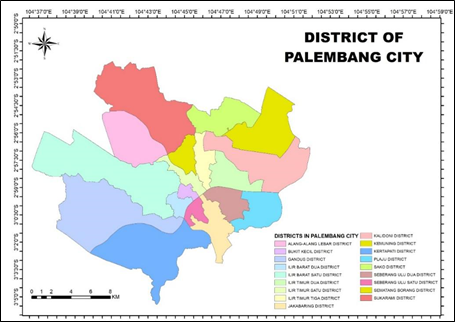
The increasing intensity of rainfall in Palembang City has heightened the risk of hydrometeorological disasters, particularly flooding and inundation. Despite various efforts by the municipal government to mitigate these events, flooding continues to occur following episodes of high or prolonged moderate rainfall. This study analyzes flood mitigation strategies with focus on community participation in addressing recurring inundation. Data from a flood distribution map reveal 196 flood points across the city, with flood heights ranging from 20 to 50 cm, occurring on average 10-15 times annually and typically receding within 2 to 4 hours though longer durations are observed in several sub-districts. Surveys and interviews conducted in 18 sub-districts identified key contributing factors, including drainage obstruction due to waste, sedimentation, vegetation, unauthorized construction, limited catchment areas, and inadequate drainage connectivity. Additional challenges include diminished retention pond capacity caused by vegetation overgrowth, functional conversion, embankment erosion, and topographical disadvantages such as low-lying terrain. The study proposes the optimization and restoration of drainage infrastructure, community empowerment in catchment area management, and the installation of additional pumps and automated sluice gates as integrated solutions. These measures aim to enhance water flow and reduce the frequency and impact of flooding in Palembang City.
Downloads
References
Anjarwati, S., Ery Suhartanto and Linda Prasetyorini (2024) ‘Aplikasi Sistem Informasi Geografis (SIG) Untuk Pemetaan Daerah Rawan Banjir Sebagai Upaya Mitigasi Di DAS Laweyan’, Jurnal Teknologi dan Rekayasa Sumber Daya Air, 4(02), pp. 1386–1399.
Annisa Temrin, S.N. and Awang, A. (2017) ‘Bencana banjir dan tahap pengetahuan penduduk terhadap pengurusan banjir di Serian, Sarawak’, Malaysian Journal of Society and Space, 13(4), pp. 22–36.
Arifin, M. et al. (2021) ‘Konsep Penanganan Bencana Banjir pada Perumahan Perumnas Manggala Kota Makassar’, Jurnal Tepat: Applied Technology Journal for Community Engagement and Services, 4(2), pp. 151–165.
BNPB (2024) Info Bencana: Data dan Informasi Kebencanaan Bulanan Teraktual, Badan Nasional Penanggulangan Bencana (BNPB).
BPS (2021) Kota Palembang Dalam Angka 2021, Badan Pusat Statistik Kota Palembang.
Briantama, R.H., Suhartanto, E. and Sajali, M.A. (2024) ‘Analisis Hidrologi dan Hidrolika Sungai Untuk Pemodelan Banjir Sebagai Upaya Mitigasi Bencana Pada Sungai Kali Surabaya’, Jurnal Teknologi dan Rekayasa Sumber Daya Air, 4(1), pp. 969–981.
Chandra, R.K. and Supriharjo, R.D. (2013) ‘Mitigasi Bencana Banjir Rob di Jakarta Utara’, Jurnal Teknik Pomits, 2(1), pp. 25–30.
Ferianto, K. and Hidayati, U.N. (2019) ‘Efektifitas Pelatihan Penanggulangan Bencana Dengan Metode Simulasi Terhadap Perilaku Kesiapsiagaan Bencana Banjir Pada Siswa SMAN 2 Tuban’, Jurnal Kesehatan Mesencephalon, 5(2), pp. 88–94.
Findayani, A. (2015) ‘Kesiap Siagaan Masyarakat Dalam Penanggulangan Banjir Di Kota Semarang’, Jurnal Geografi Media Infromasi Pengembangan Ilmu dan Profesi Kegeografian, 12(1), pp. 102–114.
Idrat, V. et al. (2024) ‘Analysis of Flood Discharge Changes in the Watershed of the Bendung Area, Palembang City’, Proceedings of the 7th FIRST 2023 International Conference on Global Innovations (FIRST-T3 2023) [Preprint], (October).
Indrayani, I. et al. (2016) ‘The Analysis Of Geotechnical And Topographical Aspects Based On Gis As Initial Identification Of Road Alignment Determination On Swamp Areas’, Proceedings of the 4th ICSBE International Conference on Sustainable Built Environment, pp. 350–359.
Indrayani, I. et al. (2018) ‘Analysis of puddles in swamp areas of banyuasin district using the image lands at 8 by NDWI method’, Ecology, Environment and Conservation, 24(3), pp. 1069–1075.
Indrayani, I. et al. (2022) ‘Utilization of Remote Sensing Technology for Flood Distribution in Palembang City Web-based’, Proceedings of the 5th FIRST T1 T2 2021 International Conference (FIRST-T1-T2 2021), 9, pp. 38–42.
Jafar, A., Mapa, M.T. and Sakke, N. (2016) ‘Impak Aktiviti Pembangunan Terhadap Trend Kekerapan Dan Magnitud Banjir Di Lembangan Sungai Menggatal, Kota Kinabalu, Sabah’, Jurnal Kinabalu [Preprint].
Kamil, E.M., Asysyauki, A.H. and Diem, A.F. (2023) ‘Pendekatan Rancang Kota pada Masalah Banjir Kota Palembang’, Jurnal TekstuReka, 1, pp. 14–24.
Laurensz, B. et al. (2019) ‘Potensi Resiko Banjir dengan Menggunakan Citra Satelit (Studi Kasus : Kota Manado, Provinsi Sulawesi Utara)’, Indonesian Journal of Computing and Modeling, 2, pp. 17–24.
Lestari, S.P., Suhartanto, E. and Andawayanti, U. (2024) ‘Penerapan Sistem Informasi Geografis Untuk Analisis Daerah Rawan Banjir Di DAS Rejoso Sebagai Upaya Mitigasi Banjir’, Jurnal Teknologi dan Rekayasa Sumber Daya Air, 4(02), pp. 1379–1392.
Muhammad Yusoff, S.Y. and Thomas, R. (2021) ‘Pemetaan Titik Panas Banjir Kilat Di Kuala Lumpur’, Malaysian Journal of Tropical Geography, 47(1–2), pp. 123–142.
Prasasti, D.T., Suhartanto, E. and Prasetyorini, L. (2024) ‘Aplikasi Penginderaan Jauh dan SIG untuk Pemetaan Daerah Rawan Banjir Sebagai Upaya Mitigasi Bencana di DAS Petung’, Jurnal Teknologi dan Rekayasa Sumber Daya Air, 4(02), pp. 1400–1414.
Putra, D. et al. (2022) ‘Penilaian Risiko Dan Kerusakan Banjir Flash Di Batu, Jawa Timur’, Jurnal Teknosains, 12(1), pp. 72–84.
Qalbi, H.B., Abdullah, F. and Ismail, N. (2024) ‘Impact on Extreme Rainfall and Flood Events during Boreal Summer Intraseasonal Oscillation (BSISO) in Aceh Province, Indonesia’, Journal of Geoscience, Engineering, Environment, and Technology, 9(4), pp. 426–432.
Rahmawati, R., Nurhapsa, N. and Fahmi, A. (2024) ‘Analysis Of Community And Practitioner Perceptions Of Biopori-Based Water Treatment Technologies In The Context Of Flood Resistance’, Journal of Geoscience, Engineering, Environment, and Technology, 9(4), pp. 433–443.
Ramsof, R.A. et al. (2025) ‘Potential Hazards of Erosion and Conservation Strategis in the Sail Sub- Watershed, Pekanbaru City, Riau Province, Indonesia’, Journal of Geoscience, Engineering, Environment, and Technology, 10(1), pp. 15–22.
Rosyidie, A. (2013) ‘Banjir: Fakta dan Dampaknya, Serta Pengaruh dari Perubahan Guna Lahan Arief’, Jurnal Perencanaan Wilayah dan Kota, 24(3), pp. 241–249.
Sadisun, I.A. (2008) ‘Pemahaman Karakteristik Bencana : Aspek Fundamental dalam upaya mitigasi dan penanganan tanggap darurat bencana’, Conference: Gladian Panji Geografi, (October 2008), pp. 1–11.
Saputra, R.H. et al. (2024) Identification of Flood Distribution Per District Based on GIS in Palembang City. Atlantis Press International BV.
Sebastian, L. (2008) ‘Flood Prevention and Control Approach’, Dinamika Teknik Sipil, 8, pp. 162--169.
Seno, A. (2013) ‘Characterization Of Flash Flood Disaster In Indonesia’, Jurnal Sains dan Teknologi Indonesia, 15(1), pp. 42–51.
Setiawan, H. et al. (2020) ‘Analisis Penyebab Banjir di Kota Samarinda’, Jurnal Geografi Gea, 20(1), pp. 39–43.
Sudarmadjii, S. et al. (2024) ‘The identification of retention ponds for flood management in Palembang City’, Proceedings of the 7th FIRST 2023 International Conference on Global Innovations (FIRST-ESCSI 2023) [Preprint], (October).
Taryana, A., El Mahmudi, M.R. and Bekti, H. (2022) ‘Analisis Kesiapsiagaan Bencana Banjir Di Jakarta’, JANE - Jurnal Administrasi Negara, 13(2), p. 302.
Zal, W.A.A. (2018) ‘Community Resilience Among Flood Victims In The East Coast Of Peninsular Malaysia In The Context Of Community Capitals’, Journal of Nusantara Studies, 3(2), pp. 41–53.
Downloads
Published
Issue
Section
License
Copyright (c) 2025 Journal of Geoscience, Engineering, Environment, and Technology

This work is licensed under a Creative Commons Attribution-ShareAlike 4.0 International License.
Copyright @2019. This is an open-access article distributed under the terms of the Creative Commons Attribution-ShareAlike 4.0 International License which permits unrestricted use, distribution, and reproduction in any medium. Copyrights of all materials published in JGEET are freely available without charge to users or / institution. Users are allowed to read, download, copy, distribute, search, or link to full-text articles in this journal without asking by giving appropriate credit, provide a link to the license, and indicate if changes were made. All of the remix, transform, or build upon the material must distribute the contributions under the same license as the original.