Characteristic of the Source Rock Of The Lahat and Talang Akar With Crude Oil In Sarolangun, Jambi sub-basin, Indonesia
DOI:
https://doi.org/10.25299/jgeet.2025.10.4.17999Keywords:
Geochemsitry, Source rock, Jambi Sub-BasinAbstract
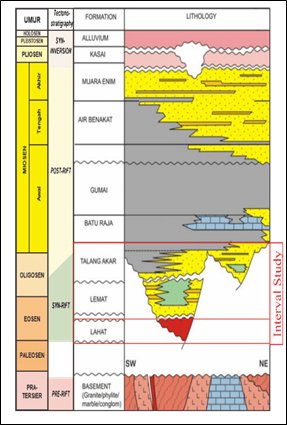
The research location is situated in Sarolangun, Jambi Province, within the Jambi Sub-Basin. Oil has been produced in the Jambi Sub-Basin study area from Paleogene-Neogene aged source rocks. However, the success ratio of oil discovery in the Jambi Sub-Basin remains at 51%. This study aims to determine the geochemical aspects in characterizing the source rocks and oil. The data used for analysis include total organic carbon, rock pyrolysis, vitrinite reflectance, and biomarkers.Geochemical characterization of the Lahat Formation source rock reveals a kerogen type II-III, generating oil and gas, while the Talang Akar Formation has a kerogen type II, producing oil, and the upper part of the Talang Akar Formation also has a kerogen type II, generating oil. The Lahat Formation biomarker consists of higher plants and algae in anoxic conditions, with high C29 sterane and early mature Tm/Ts ratio. The lower part of the Talang Akar Formation biomarker has lacustrine-marine algae organic material in anoxic conditions, with high C27 sterane and early mature Tm/Ts ratio. The upper part of the Talang Akar Formation biomarker has higher plant and marine algae organic material, with high oleanane and early mature Tm/Ts ratio. The produced oil has biomarker characteristics indicating deposition in anoxic conditions, with a mix of algae-higher plant organic material, and early mature Tm/Ts ratio. Based on these results, the oil is positively correlated with the Talang Akar Formation, indicating that the organic material originates from a marine or lacustrine depositional environment.
Downloads
References
Afifah, P.D. and Setiawan, B. (2019) ‘Middle Miocene Black Shale of Airbenakat Formation in Berau Areas, Jambi: are they potential source rock?’, Journal of Geoscience, Engineering, Environment, and Technology, 4(2), p. 128.
Bishop, M.G. (2001) ‘South Sumatra Basin Province, Indonesia: The Lahat/Talang Akar-Cenozoic Total Petroleum System’, USGS Open File Report, (99-50-S), p. 22
Connan, J. and Cassou, A.M. (1980) ‘Properties of gases and petroleum liquids derived from terrestrial kerogen at various maturation levels’, Geochimica et Cosmochimica Acta, 44(1), pp. 1–23.
Connan, J. et al. (1986) ‘The microbial input in carbonate-anhydrite facies of a sabkha palaeoenvironment from Guatemala: A molecular approach’, Organic Geochemistry, 10(1–3), pp. 29–50.
Cheng, P. et al. (2013) ‘Source controls on geochemical characteristics of crude oils from the Qionghai Uplift in the western Pearl River Mouth Basin, offshore South China Sea’, Marine and Petroleum Geology, 40(1), pp. 85–98.
Didyk et al., 1978 ‘Lacustrine source rock deposition in response to co-evolution of environments and organisms controlled by tectonic subsidence and climate, Bohai Bay Basin, China’, Organic Geochemistry, 42(4), pp. 323–339.
Duan et al., 2008 ‘Geochemical study of crude oils from the Xifeng oilfield of the Ordos basin, China’, Journal of Asian Earth Sciences, 31(4–6), pp. 341–356.
Ginger, D. and Fielding, K. (2005) ‘THE PETROLEUM SYSTEMS AND FUTURE POTENTIAL OF THE SOUTH SUMATRA BASIN’, in Proceedings, Indonesian Pteroleum Asociation Thirtieth Annual Convention & Exhibition, August 2005, pp. 67–90.
Grosjean, E. et al. (2012) ‘Geochemical evidence for an Early Cambrian origin of the “Q” oils and some condensates from north Oman’, Organic Geochemistry, 45, pp. 77–90.
Huang, W.Y. and Meinschein, W.G. (1979) ‘Sterols as ecological indicators’, Geochimica et Cosmochimica Acta, 43(5), pp. 739–745.
Hakimi, M.H., Abdullah, W.H. and Shalaby, M.R. (2011) ‘Organic geochemical characteristics of crude oils from the Masila Basin, eastern Yemen’, Organic Geochemistry, 42(5), pp. 465–476.
Hao, F. et al. (2011) ‘Lacustrine source rock deposition in response to co-evolution of environments and organisms controlled by tectonic subsidence and climate, Bohai Bay Basin, China’, Organic Geochemistry, 42(4), pp. 323–339.
Jamaluddin, Maria and Ryka, H. (2019) ‘Karakterisasi Potensi Batuan Induk Hidrokarbon Berdasarkan Analisis Geokimia Material Organik Sumur Jmb, Sub-Cekungan Jambi, Cekungan Sumatra Selatan’, Prosiding Seminar Nasional Teknologi V, pp. 18–26.
Magoon, L.B. and Dow, W.G. (1994) ‘Petroleum system’, Journal of the Japanese Association for Petroleum Technology, 60(3), pp. 3–23.
Muthasyabiha, S.R. et al. (2020) ‘IPA20-SG-251_Muthasyabiha.pdf’, in. Proceeding, Indonesian Petroleum Association Digital Technical Conerence, 14-17 September 2020.
Pulunggono, A. (2018) ‘Pre-Tertiary and Tertiary fault systems as a framework of the South Sumatra Basin; a study of SAR-maps’.
Rabbani, A.R. et al. (2014) ‘Geochemical characteristics and genetic types of the crude oils from the Iranian sector of the Persian Gulf’, Organic Geochemistry, 70, pp. 29–43.
Rajagukguk, Y.M. and Jati, S.N. (2018) ‘Macerals Analysis Seam M2 Muaraenim Formation, : Implication Toward Coal Facies and Coal Rank in Kendi Hill, South Sumatra’, Journal of Geoscience, Engineering, Environment, and Technology, 3(2), p. 94.
Satyana, A.H. and Purwaningsih, M. (2003) ‘Geochemistry of the East Java Basin: New Observations on Oil Grouping, Genetic Gas Types.
Sutriyono, E., Hastuti, E.W.D. and Susilo, B.K. (2016) ‘Geochemical assessment of Late Paleogene synrift source rocks in the South Sumatra basin’, International Journal of GEOMATE, 11(1), pp. 2208–2215.
Setyawan, R. et al. (2020) “Shale Gas in Jambi Sub-Basin, South Sumatra Basin, Indonesia: Insights From Geochemical And Geomeachanical Studies,” Journal of Geoscience, Engineering, Environment, and Technology, 5(2), pp. 94–102.
Syaifuddin, M. (2016) ‘Organic Geochemical Characteristic Of Crude Oils From Orange Graben, South Sumatra Basin’, Journal of Geoscience, Engineering, Environment, and Technology, 1(1), p. 25.
Syamsuddin, E. et al. (2019) ‘Bio-markers based oil to source rock correlation and paleo-environmental interpretation: A case study from Talang Akar Formation, South Sumatra Basin, Indonesia’, Journal of Physics: Conference Series, 1341(8).
Syaifudin, M. and Subroto, E.A. (2024) ‘Geochemical Characterizations of Crude Oils in Pendopo High and Limau Graben, South Sumatra Basin’, Indonesian Journal on Geoscience, 11(1), pp. 1–13.
Tao, S. et al. (2015) ‘Geochemical application of tricyclic and tetracyclic terpanes biomarkers in crude oils of NW China’, Marine and Petroleum Geology, 67, pp. 460–467.
Wibowo, S.S. and Subroto, E.A. (2017) ‘Pemodelan Kematangan Batuan Induk Formasi Talangakar pada Blo k Tungkal, Cekungan Sumatera Selatan’, Bulletin of Geology, 1(1), pp. 54–64.
Wang, Q. et al. (2015) ‘Geochemical characterization of QHD29 oils on the eastern margin of Shijiutuo uplift, Bohai Sea, China: Insights from biomarker and stable carbon isotope analysis’, Marine and Petroleum Geology, 64, pp. 266–275.
X. et al. (2013) ‘Geochemistry and possible origin of petroleum in Palaeozoic reservoirs from Halahatang Depression’, Journal of Asian Earth Sciences, 74, pp. 129–141.
Zumberge, J.E. (1987) ‘Terpenoid biomarker distributions in low maturity crude oils’, Organic Geochemistry, 11(6), pp. 479–496.
Zajuli, H.H. et al. (2023) ‘Karakteristik Geokimia Organik dan Indeks Kegetasan Serpih Berumur Eosen-Oligosen di Sub Cekungan Jambi, Cekungan Sumatera Selatan Organic Geochemistry And Britleness Index Characteristics of Eocene-Oligocene Shale in Jambi Sub-Basin , South Sumatra Basin’, 24(1), pp. 11–22.
Downloads
Published
Issue
Section
License
Copyright (c) 2025 Journal of Geoscience, Engineering, Environment, and Technology

This work is licensed under a Creative Commons Attribution-ShareAlike 4.0 International License.
Copyright @2019. This is an open-access article distributed under the terms of the Creative Commons Attribution-ShareAlike 4.0 International License which permits unrestricted use, distribution, and reproduction in any medium. Copyrights of all materials published in JGEET are freely available without charge to users or / institution. Users are allowed to read, download, copy, distribute, search, or link to full-text articles in this journal without asking by giving appropriate credit, provide a link to the license, and indicate if changes were made. All of the remix, transform, or build upon the material must distribute the contributions under the same license as the original.