Comparison of Laminar, RNG, and LES Model for Wave Propagation Simulation with FLOW-3D
DOI:
https://doi.org/10.25299/jgeet.2025.10.3.13933Keywords:
Numerical Modeling, CFD, FLOW-3D, Laminar, RNG, LESAbstract
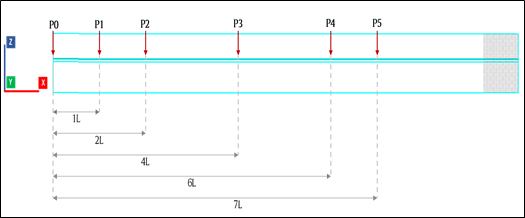
Understanding wave transformation and its interaction with coastal structures is critical for shoreline protection and design. While physical modeling has traditionally supported such studies, its high cost has led to increased reliance on numerical modeling. This study uses FLOW-3D to simulate wave propagation in a scaled 2D coastal wave channel and compares the performance of three turbulence models: Laminar, Renormalized Group (RNG) k-ε, and Large Eddy Simulation (LES). Simulations are based on a 3-meter wave height, 12-second period, and 7-meter water depth, with wave elevation recorded at six probes along the domain. Results show that the LES model achieved the most accurate prediction, with a significant wave height of 3.01 meters at the structure location—an error of only 0.33%—outperforming RNG and laminar models. These findings highlight the superior turbulence resolution of LES in capturing energy dissipation and wave evolution. The study provides practical guidance for coastal engineers in selecting turbulence models based on accuracy and computational trade-offs. Future research should include model validation with experimental or field data and extend to irregular wave conditions to enhance real-world applicability.
Downloads
References
Baranya, S., Jozsa, J., 2006. Flow Analysis In River Danube By Field Measurement and 3D CFD Turbulence Modelling. Periodica Polytechnica (Budapest University of Technology and Economics 50, 57–68.
Boehler, M., Sudesh, A., Turner, M., 2020. Hybrid RANS-LES of Shaped Hole Film Cooling on an Adiabatic Flat Plate at Low Reynolds Number. Open Journal of Fluid Dynamics 10, 317–341.
Chang, Y.S., Do, J.D., Jeong, W.M., Hyun, S.K., Baek, W.-D., Choi, J.H., Jin, J.-Y., 2020. Comparison of Turbulent Flows and Suspended Sediment Particle Motions Simulated around a Submerged Breakwater Using RANS and LES. Ocean Science Journal 55, 1–16.
Dogan, S., Yagmur, S., Goktepeli, I., Ozgoren, M., 2017. Assessment of Turbulence Models for Flow around a Surface-Mounted Cube. International Journal of Mechanical Engineering and Robotics Research 237–241.
Duró, G., De Dios, M., López, A., Liscia, S.O., 2012. Physical Modeling and CFD Comparison: Case Study of a Hydro-Physical Modeling and CFD Comparison: Case Study of a Hydro-Combined Power Station in Spillway Mode Combined Power Station in Spillway Mode PHYSICAL MODELING AND CFD COMPARISON: CASE STUDY OF A HYDRO-COMBINED POWER STATION IN SPILLWAY MODE.
Ettema Robert, Arndt, R., Roberts, P., Wahl, T., 2000. Hydraulic modeling: Concepts and practice. American Society of Civil Engineers.
FLOW-3D, 2019. FLOW-3D® v.12 Users Manual.
Georgoulas, A.N., Angelidis, P.B., Panagiotidis, T.G., Kotsovinos, N.E., 2010. 3D Numerical modelling of turbidity currents. Environmental Fluid Mechanics 10, 603–635.
Giannissi, S.G., Tolias, I.C., Melideo, D., Baraldi, D., Shentsov, V., Makarov, D., Molkov, V., Venetsanos, A.G., 2021. On the CFD modelling of hydrogen dispersion at low-Reynolds number release in closed facility. Int J Hydrogen Energy 46, 29745–29761.
Gildeh, H.K., 2013. Numerical Modeling of Thermal/Saline Discharges in Coastal Waters.
Guo, G., Zhang, R., Yu, H., 2020. Evaluation of different turbulence models on simulation of gas-liquid transient flow in a liquid-ring vacuum pump. Vacuum 180, 109586.
Hager, W.H., Pfister, M., 2010. Hydraulic modelling – an introduction: principles, methods and applications. Journal of Hydraulic Research 48, 557–558.
Heydari, M., KhoshKonesh, A., 2016. The Comparison of the Performance of Prandtl| Mixing Length, Turbulence Kinetic Energy, K-e, RNG and LES Turbulence Models in Simulation of the Positive Wave Motion Caused by Dam Break on the Erodible Bed. Indian J Sci Technol 9.
Ho, D., Boyes, K., Donohoo, S., Cooper, B., 2003. Numerical Flow Analysis for Spillways, in: 43rd ANCOLD Conference. pp. 24–29.
Huggins, D.L., Piedrahita, R.H., Rumsey, T., 2004. Analysis of sediment transport modeling using computational fluid dynamics (CFD) for aquaculture raceways. Aquac Eng 31, 277–293.
Hugues, S., 1996. Physical Models and Laboratory Techniques in Coastal Engineering.
Khoirunnisa, H., Arif Rachman, R., Sari Ningsih, N., Syamsudin, F., 2020. The Role of Decadal Kelvin Wave in the Western of Sumatra and Along the South Coast of Java using Frequency-Wavenumber 2D Spectral Analysis. Journal of Geoscience, Engineering, Environment, and Technology 5, 40–46.
Kim, S.-D., Lee, H.-J., An, S.-D., 2010. Improvement of hydraulic stability for spillway using CFD model, International Journal of the Physical Sciences.
Kumari, S., Tiwari, H.L., Chavan, R., 2025. Analyzing the effectiveness of turbulence models in predicting flow around tandem piers. Ocean Engineering 321, 120467.
Lee, H.C., Wahab, A.K.A., 2019. Performance of different turbulence models in predicting flow kinematics around an open offshore intake. SN Appl Sci 1, 1266.
Liu, D., Tang, W., Wang, J., Xue, H., Wang, K., 2016. Comparison of laminar model, RANS, LES and VLES for simulation of liquid sloshing. Applied Ocean Research 59, 638–649.
Ondara, K., Dhiauddin, R., Wisha, U.J., Rahmawan, G.A., 2020. Hydrodynamics Features and Coastal Vulnerability of Sayung Sub-District, Demak, Central Java, Indonesia. Journal of Geoscience, Engineering, Environment, and Technology 5, 32–39.
Parsaie, A., Haghiabi, A.H., 2017. Computational Modeling of Pollution Transmission in Rivers. Appl Water Sci 7, 1213–1222.
Parsaie, A., Haghiabi, A.H., Moradinejad, A., 2015a. CFD modeling of flow pattern in spillway’s approach channel. Sustain Water Resour Manag 1, 245–251.
Parsaie, A., Yonesi, H.A., Najafian, S., 2015b. Predictive modeling of discharge in compound open channel by support vector machine technique. Model Earth Syst Environ 1.
Protsenko, S. V., 2024. Modelling Turbulent Flows near Coastal Structures Using Various Turbulence Models. Computational Mathematics and Information Technologies 8, 55–62.
Reno Arief Rachman, Haryo Dwito Armono, Dinar Catur istiyanto, Khusnul Setia Wardani, Hanah Khoirunnisa, Reni Wijayanti, 2023. Study of Hydrodynamic Patterns of Tanjung Pasir Banten Waters to Support the NCICD Sea Wall Development Plan. Journal of Geoscience, Engineering, Environment, and Technology 8, 1–9.
Roy-Biswas, T., Sen, D., 2022. Critical analysis of turbulence models for simulating positive surge waves in open channels in a RANS-VOF setup. Environmental Fluid Mechanics 22, 1253–1281.
Sahu, M., Khatua, K.K., Patra, K.C., Naik, T., 2009. Developed Laminar Flow In Pipe Using Computational Fluid Dynamics, in: 7th International R &D Conference on Development and Management of Water and Energy Resources. Bhubaneswar.
Savage, B.M., Johnson, M.C., 2001. Flow over Ogee Spillway: Physical and Numerical Model Case Study. Journal of Hydraulic Engineering 127, 640–649.
Simons, T.J., 1974. Verification of Numerical Models of Lake Ontario. J Phys Oceanogr Volume 4, 507–523.
Suprapto, M., 2013. Increase spillway capacity using labyrinth weir, in: Procedia Engineering. Elsevier Ltd, pp. 440–446.
Tominaga, Y., Stathopoulos, T., 2011. CFD modeling of pollution dispersion in a street canyon: Comparison between LES and RANS. Journal of Wind Engineering and Industrial Aerodynamics 99, 340–348.
Versteeg, H.K., Malalasekera, W., 2007. An Introduction to Computational Fluid Dynamics: The Finite Volume Method, Second Edition. ed. Pearson Education Limited, Edinburgh Gate.
Yakhot, V., Orszag, S.A., 1986. Renormalization Group Analysis of Turbulence I. Basic Theory. J Sci Comput Volume 1.
Yalcin, E.E., Ikinciogullari, E., Kaya, N., 2023. Comparison of Turbulence Methods for a Stepped Spillway Using Computational Fluid Dynamics. Iranian Journal of Science and Technology, Transactions of Civil Engineering 47, 3895–3911.
Downloads
Published
Issue
Section
License
Copyright (c) 2025 Journal of Geoscience, Engineering, Environment, and Technology

This work is licensed under a Creative Commons Attribution-ShareAlike 4.0 International License.
Copyright @2019. This is an open-access article distributed under the terms of the Creative Commons Attribution-ShareAlike 4.0 International License which permits unrestricted use, distribution, and reproduction in any medium. Copyrights of all materials published in JGEET are freely available without charge to users or / institution. Users are allowed to read, download, copy, distribute, search, or link to full-text articles in this journal without asking by giving appropriate credit, provide a link to the license, and indicate if changes were made. All of the remix, transform, or build upon the material must distribute the contributions under the same license as the original.